
News
Concerns rise over referee bias as Messi's preferred official takes charge
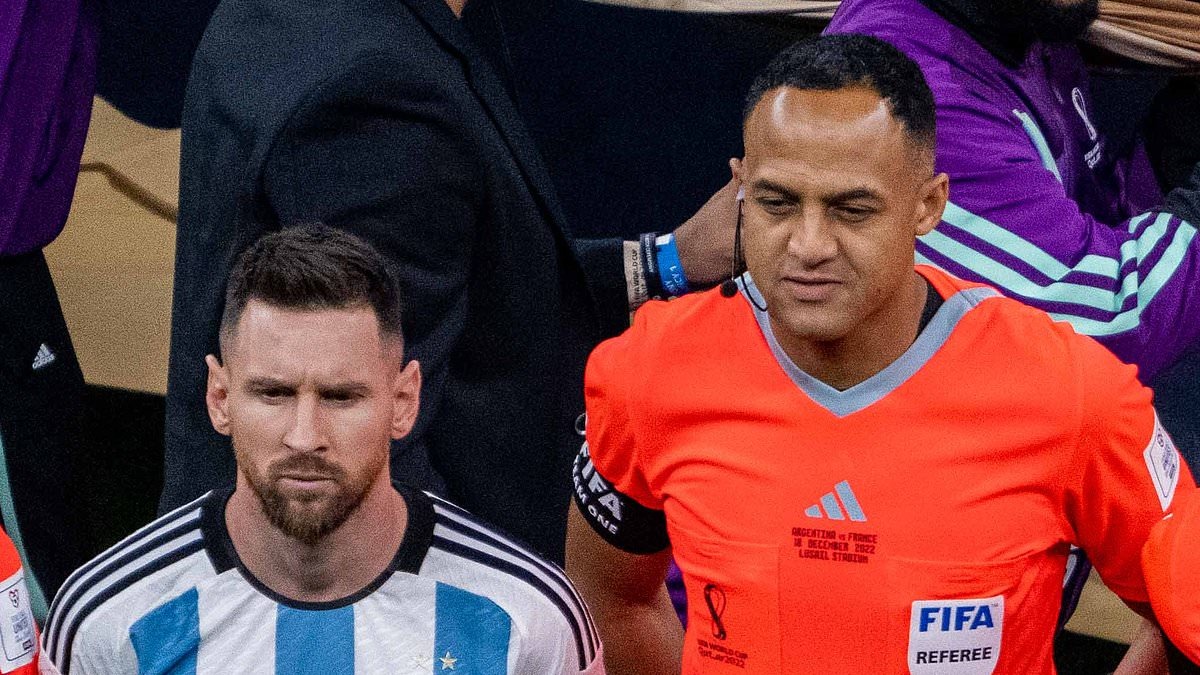
Fears of World Cup bias towards Argentina have intensified following FIFA's announcement that Lionel Messi's preferred referee will officiate England's eagerly awaited semi-final against the reigning champions.
Argentina have not performed at their best leading up to Wednesday's thrilling match with the Three Lions, having narrowly defeated Egypt and Switzerland in controversial circumstances during the last-16 and quarter-finals respectively.
The nature of those wins, where Egypt had a goal controversially disallowed and Switzerland's Breel Embolo was sent off, has sparked significant backlash and speculation that FIFA is attempting to assist Messi and Argentina in their quest for victory. The governing body has firmly denied these allegations.
On Tuesday, it was confirmed that Ismail Elfath will officiate this crucial match, marking the most significant occasion of his refereeing career at Atlanta Stadium on Wednesday. England aims to reach their first World Cup final since 1966, while Argentina seeks to compete in consecutive finals.
The Moroccan-born American, assisted by compatriots Corey Parker and Kyle Atkins, will oversee his fourth match of this World Cup, having yet to referee either England or Argentina this summer. Italian Maurizio Mariani will serve as the fourth official.
Elfath was the fourth official during the 2022 World Cup final when Argentina triumphed over France, and his interactions with Messi have increased since the forward joined MLS side Inter Miami in July 2023.
A month after joining Inter Miami, Messi helped his team secure the Leagues Cup final against Nashville SC, a match officiated by Elfath. Messi scored the opening goal with a powerful strike from outside the box before Nashville equalised. The game ultimately went to penalties, with Miami winning 10-9, and Messi converting their first spot-kick.
The 44-year-old has officiated Messi four times at club level, with all four matches resulting in victories for Messi's side, raising concerns for England ahead of the semi-final.
Since moving to the United States, Messi has encountered Elfath four times, winning each time. In addition to the Leagues Cup final, Messi has scored four goals across the other three MLS matches officiated by Elfath.
England players should be cautious, as Elfath's record in MLS this season suggests he is not shy about issuing cards. In 10 matches before the World Cup break, he handed out 41 yellow cards, sent off three players, and awarded three penalties.
Elfath's officiating style has been consistent in this World Cup, where he has shown eight yellow cards and one red card across three matches, including Netherlands 2-2 Japan, Spain 1-0 Uruguay, and Norway 2-1 Brazil.
His performance in the Spain-Uruguay match drew criticism from the Spanish media, who claimed he was not strict enough with the Uruguayans, leading to a tense encounter. Late in the second half, Uruguay's Agustin Canobbio received a red card for a high challenge on Pau Cubarsi.
The Spanish media's main complaint stemmed from a challenge by Nicolas De La Cruz on Nico Williams, which left the latter injured. Williams described it as "one of the worst days of my life" after the match, although he played in the final minutes of their quarter-final win over Portugal.
Elfath's most recent match also featured a controversial moment when he initially rejected Brazil's appeal for a penalty after Norway's Kristoffer Ajer fouled Matheus Cunha. However, VAR intervened, and Elfath reversed his decision, leading to a saved penalty from Bruno Guimaraes.
Messi and Argentina have faced scrutiny throughout this World Cup, with claims of referee bias in their favour. The latest incident occurred on Saturday when Switzerland's Manuel Akanji stated that everything was "against us" following their 3-1 quarter-final exit in extra time.
Switzerland's players and manager were furious after Embolo became the first player to be sent off under a new rule for mistaken identity.
With the quarter-final tied at 72 minutes, Embolo received a second yellow card after a VAR review determined he had dived rather than being fouled by Argentina's Leandro Paredes. A new rule introduced for this World Cup allows for a decision to be changed if a player is booked or sent off for a foul that was actually committed by an opponent.
Reflecting on the match, Akanji expressed his frustration, stating: "Every little thing was called against us" and "I've never experienced such a one-sided game." Manager Murat Yakin described the refereeing as "incomprehensible."
Last week, FIFA's refereeing chief Pierluigi Collina condemned those questioning the integrity of World Cup officials, asserting that they cannot be influenced by anyone, following Egypt's complaints after their last-16 defeat to Argentina.
The reigning champions rallied from 2-0 down after 78 minutes to win 3-2 in Atlanta, with Egypt's manager Hossam Hassan later accusing FIFA of rigging the tournament in favour of Messi.
Hassan's protests were amplified by footage showing him angrily confronting Argentina in the tunnel after the final whistle.
In response to the officiating criticisms, Collina dismissed the allegations against his staff and highlighted the broader consequences such accusations can have on the individuals involved.
When asked by FIFA.com about his observations of the World Cup thus far, Collina stated: "Let’s start by saying that we have now played 50 per cent more matches than at the FIFA World Cup Qatar 2022, and there are still eight more huge games to be played. Overall, we are happy. However, with such a high number of matches played in a relatively short period of time, it is normal that some things do not go as expected. When that happens, they are ready to work even harder to ensure they are fully prepared for the next match."
He added: "Of course, constructive discussion about decisions will always be part of football, but unfounded allegations have no place in our sport. Nobody can question the integrity of the FIFA World Cup match officials. When this happens, it may provoke reactions that lead to threats against them and their families. This is not right."
Collina emphasised that FIFA refereeing cannot be influenced by anyone, not even FIFA President Gianni Infantino, who has always supported the referees while trusting them to operate independently. He concluded that match officials make honest decisions and strive to perform their best, just like players and coaches.
Source: Mail Online